Pearson Edexcel · GCSE · Business
Course version: 1BS0 · Version from Sept 2017
What business aims and business objectives are.
Full specification wording
Business aims and objectives: What business aims and business objectives are.
A business aim is a broad, long-term overarching goal that a business wants to achieve, such as becoming the market leader or surviving the first year of trading.
Checked against the Pearson Edexcel 1BS0 specification (opens in a new tab) on .
- Point 1 of 2
- 2 key terms
Study notes
From the checked teaching notes for this specification point.
The idea
A business aim is a broad, long-term overarching goal that a business wants to achieve, such as becoming the market leader or surviving the first year of trading. In contrast, business objectives are the specific, measurable, and time-bound targets set to help achieve that broader aim. For example, if a bakery's aim is to increase its market share, its specific objective might be to increase sales revenue by ten percent over the next twelve months. Objectives provide clear stepping stones and allow managers to measure performance against quantifiable targets. Understanding the distinction between the general vision (aims) and the actionable steps (objectives) is fundamental to evaluating business strategy and success.
What earns the marks
- Defining a business aim as a broad, long-term goal or vision for the business.
- Defining a business objective as a specific, measurable target that must be achieved to reach the overall aim.
- Explaining the relationship between aims and objectives, noting that objectives act as stepping stones toward the aim.
- Applying the concepts to a given scenario by identifying which stated goals are aims and which are quantifiable objectives.
Common mistakes and how to put them right
Using the terms 'aim' and 'objective' interchangeably.
Put it right: Clearly distinguish aims as broad long-term goals and objectives as specific, measurable targets.
Providing an objective without a measurable element.
Put it right: Ensure examples of objectives include specific targets, such as a percentage increase or a set timeframe.
Assuming all businesses have the same aims.
Put it right: Recognise that aims vary depending on the size, sector, and maturity of the business, such as survival for a start-up versus growth for an established firm.
Exam tips
- When asked to define an objective, always include the words 'specific' and 'measurable' in your answer.
- Look for numbers or timeframes in the case study to help you identify the business's objectives rather than its aims.
- If evaluating a business's success, compare its actual performance data against its stated objectives to form a justified conclusion.
Try the lesson
The start of the Business aims and objectives: What business aims and business objectives are. lesson, made from checked teaching notes for this specification point.
Have a go first
Which of the following best describes the difference between a business aim and a business objective?
Listen
A business aim is a broad, long-term overarching goal that a business wants to achieve, such as becoming the market leader or surviving the first year of trading. In contrast, business objectives are the specific, measurable, and time-bound targets set to help achieve that broader aim. For example, if a bakery's aim is to increase its market share, its specific objective might be to increase sales revenue by ten percent over the next twelve months. Objectives provide clear stepping stones and allow managers to measure performance against quantifiable targets. Understanding the distinction between the general vision (aims) and the actionable steps (objectives) is fundamental to evaluating business strategy and success. A strong answer earns marks for these points. Defining a business aim as a broad, long-term goal or vision for the business. Defining a business objective as a specific, measurable target that must be achieved to reach the overall aim. Explaining the relationship between aims and objectives, noting that objectives act as stepping stones toward the aim. Applying the concepts to a given scenario by identifying which stated goals are aims and which are quantifiable objectives. A common slip: Using the terms 'aim' and 'objective' interchangeably. Instead, clearly distinguish aims as broad long-term goals and objectives as specific, measurable targets. Exam tip: When asked to define an objective, always include the words 'specific' and 'measurable' in your answer.
See it
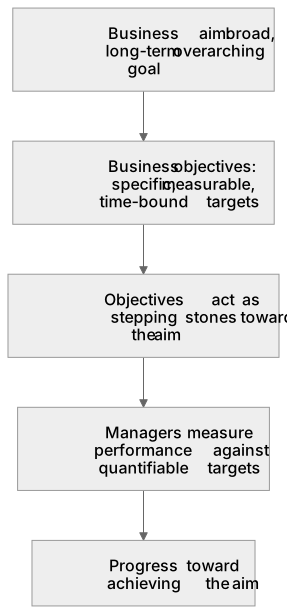
Put it in order
Put these steps in the order they happen.
- 1. Business objectives: specific, measurable, time-bound targets
- 2. Objectives act as stepping stones toward the aim
- 3. Business aim: broad, long-term overarching goal
- 4. Progress toward achieving the aim
- 5. Managers measure performance against quantifiable targets
Key words
Say what each word means before you turn the card.
Business aim
Try answering aloud or in your head before turning the card.
Business objective
Try answering aloud or in your head before turning the card.
See every definition
- Business aim
- A broad, long-term overarching goal that a business wants to achieve, such as becoming the market leader or surviving the first year of trading.
- Business objective
- A specific, measurable, and time-bound target set to help achieve a broader aim.
Label the diagram
Some boxes have lost their names. Pick the right name for each number.
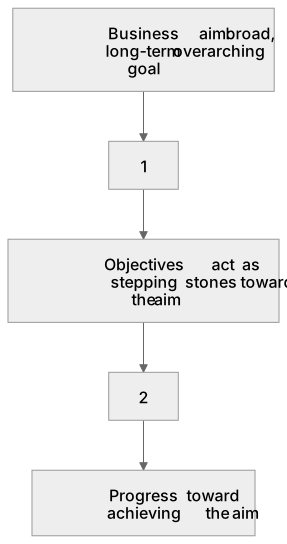
1Box 1
2Box 2
There is more to this lesson
The full lesson goes on to check your understanding and help you earn the marks. Create a free account to carry on, with your progress saved.
A week of Premium from your first lesson · Then the free plan continues · No card, no charge
Test your understanding of Business aims and objectives: What business aims and business objectives are.
Active recall beats re-reading. Take an instant quiz now to test what you’ve learned and lock it into long-term memory.
A week of Premium from your first lesson · Then the free plan continues · No card, no charge